Skip to content Skip to main navigation

2026 Shelley Peterson Student Art Exhibition

An annual exhibition celebrating the diverse artistic excellence of undergraduate students enrolled in visual studies programs across the University of Toronto’s three campuses.

Guest curated by Dallas Fellini

Works by

Sofia Lebovics, Alaya Le, Phynn Saunders, Aileen Kim, Amber Ramos, Hafsa Murtaza, Gurleen Manak, Mitsuko Noguchi, Cythial Edomwonyi, Cat Delle Fave, Maria Abu Askar, Kauri Krishnar, Kiki Zhou

Award Winners

Hafsa Murtaza, Mitsuko Noguchi, Kiki Zhou

Curatorial Statement

I am honoured to guest curate this year’s Shelley Peterson Student Art Exhibition. Celebrating the artistic excellence of undergraduate students enrolled in visual studies programs across the University of Toronto’s three campuses, this annual exhibition represents an opportunity for student artists to share their work within the context of an internationally renowned venue for contemporary art. I would like to send a heartfelt congratulations to the 13 students participating in this year’s exhibition, selected from dozens of applicants from across the three university campuses. Through diverse media, the works assembled here each pull on conceptual threads related to memory and perception, considering the ways that these phenomena can be mediated or distorted.

I would like to express my gratitude to the Art Museum staff, particularly Marianne Rellin, Micah Donovan, Barbara Fischer, and Noa Bronstein, for their collaboration in producing this exhibition. Thank you also to Kate Whiteway for her mentorship and support, to Hana Nikčević for her editing work, to Chiedza Pasipanodya for acting as this year’s guest juror, and to U of T faculty John Armstrong, Emmanuel Osahor, and Gareth Long.

– Dallas Fellini,
2026 Shelley Peterson Student Art Exhibition guest curator


The Artworks

Sofia Lebovics, Holy, holy, 2025. Video, 2:00 mins. Courtesy of the artist.

Sofia Lebovics
Holy, holy

2025
video, 2:00 mins

Campus: St. George
First Year, Visual Studies

Sofia Lebovics’s work Holy, holy indexes collective cultural memory through transfigured images of secular Jewish life.

Comprising found footage from Jewish immigrant home movies spanning the 1920s to the 2000s, Lebovics’s work contemplates the various forms that inherited ritual can take on. Scenes from different sources congregate in her video: a newlywed couple shares their first dance, a young woman brushes her child’s hair, an older man blows out birthday candles. Through these familiar scenes, Lebovics reflects on the ways that her understanding of holiness and ritual differs from that of her parents, grandparents, and great-grandparents: “While previous generations of my family had to explicitly fight for their existence and hold the practices they fought for with a delicate sacredness, my current generation sees the same holiness in the freedom to take these customs for granted.” The constellation of secular Jewish memory charted through this video exemplifies a holiness that Lebovics grounds less in religion than in autonomy and survival.

Alaya Le
Warm Plates

2026
zine, cyanotype prints on mulberry paper, 5″ x 7″, 32 pages

Campus: St. George
Fourth Year, Visual Studies; Computer Science; Science, Technology, and Society

Alaya Le’s zine Warm Plates preserves the memory of a Vietnamese family dinner and contemplates what its absence means for the Vietnamese diaspora.
Warm Plates features nine cyanotype prints on mulberry paper representing dishes typically found at a Vietnamese family dinner. Vietnamese ceramic patterns appear across the prints, along with the familiar shapes of ginger, cilantro, and scattered grains of rice. But the depicted dishes are empty, a negotiation between the family dinner itself and its ghost remains. Le writes that she is “drawn to traces that the tongue remembers; the things the Vietnamese diaspora cannot bring from their home.” The materiality of mulberry paper and the ephemeral nature of the saddle-stitched zine evoke the delicacy of memory, particularly pertinent to individuals living in diaspora. But just as Le’s zine acts as an ode to particularities of Vietnamese experiences that can be easily forgotten when living in diaspora, it also operates as a form of remembering, of indexing a connection to community and everyday gastronomies.

Phynn Saunders
Gay & Can’t Drive

2025
acrylic on Masonite, various sizes

Campus: Mississauga
Fourth Year, Theatre & Drama Studies; Art & Art History

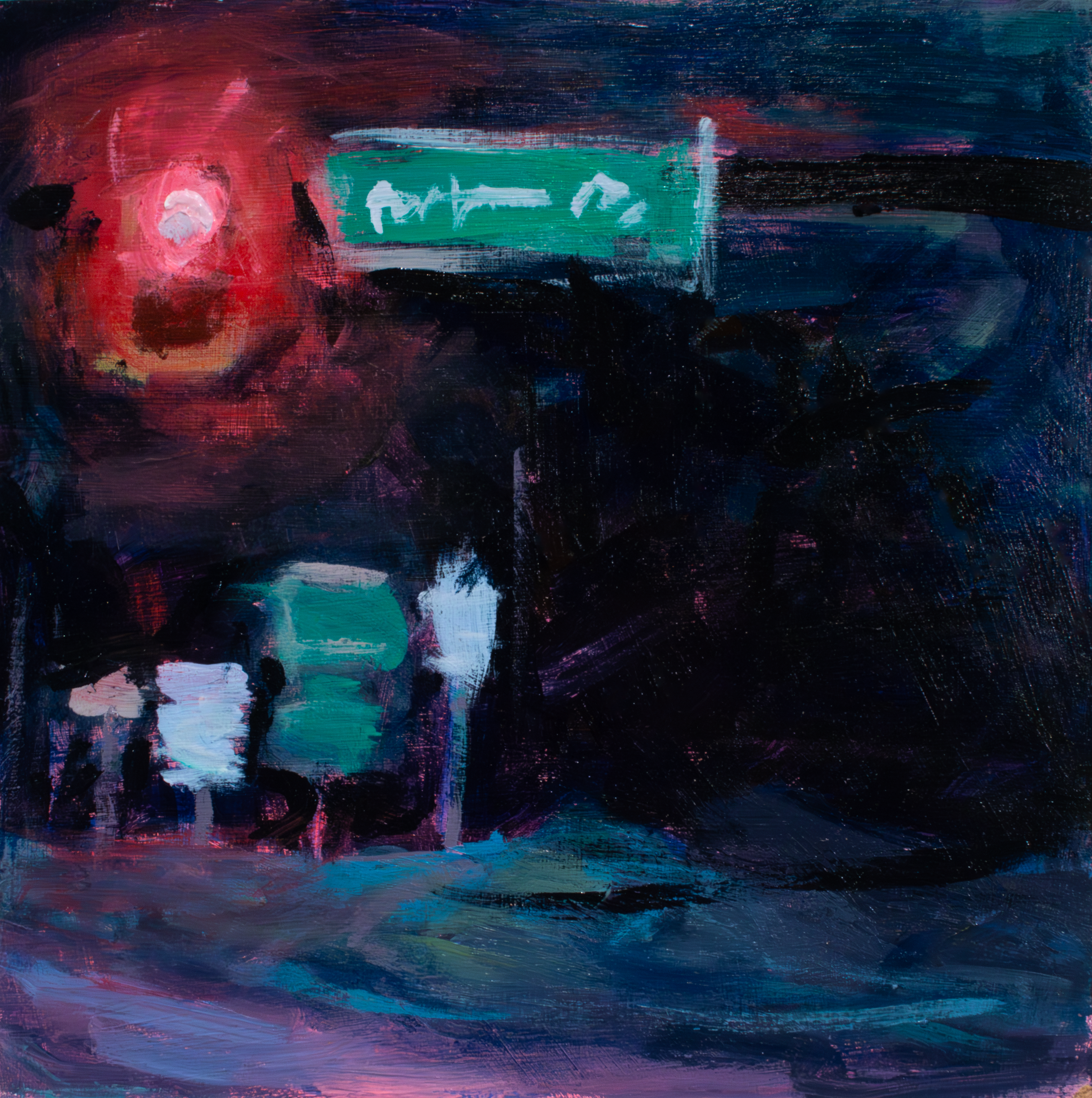
In his painting series Gay & Can’t Drive, Phynn Saunders similarly explores memory, relationality, and absence.

This series captures moments that Saunders experienced from the passenger seat of his partner’s car, the resulting images often framed by fragments of a dashboard or windshield. Saunders began Gay & Can’t Drive just after his partner was forced to move back to Texas, away from the relative safety currently offered to trans people in Canada. Navigating a new element of distance in his relationship, as well as attacks on trans rights from both sides of the border, Saunders found in this series a way to piece together memories of togetherness in the face of absence and disenfranchisement. Saunders’s loose brushstrokes materialize the glow of streetlights illuminating late-night drives and telephone wires strung across sunset skies, the liminal backdrop of a car in transit evoking an uneasiness around contemporary trans precarity

Aileen Kim,Beyond Play, 2025. Audio, 3:03 mins. Courtesy of the artist.

Aileen Kim
Beyond Play

2025
audio, 3:03 mins

Campus: St. George
Second Year, Visual Studies

In Beyond Play, Aileen Kim manipulates sounds recorded at a children’s playground, reconstituting them as an eerie and alien soundscape.

Kim’s work blurs what is recognizable to listeners through isolated and distorted audio. The sounds of swings, slides, and seesaws are pulled apart and reassembled to produce a disorienting sonic map of a familiar place. The raw materials of Kim’s sonic collage become disguised as she carefully determines how much aural information to share with her listener; choosing which sounds to preserve, which to modify, and which to obscure. Beyond Play considers and challenges preconceived notions about how perception operates, demonstrating how the familiar can be transformed to bear little resemblance to the aural reality we might remember.

Amber Ramos
Weaving
Transparencies

2025
acrylic on canvas, 24″ x 30″

Campus: St. George
Second Year, Visual Studies; Art History

Amber Ramos’s painting Weaving Transparencies represents Filipino collectivism in an exploration of opacity and generational memory.

Based on family photos from Ilocos Sur in the Philippines, the painting depicts daklis, a Filipino communal fishing method wherein a group of people come together to pull a large net towards shore. Filipino collectivism, exemplified in this community-based practice, is structured around the concept of kapwa, which signifies the importance of a shared cultural identity and the interconnectedness of the self and the other. Referencing the primitivist school of Fauvism in her colour palette and style, Ramos alludes to Western tendencies to romanticize “other,” purportedly less modern cultures; Filipino culture, she suggests, is often seen through this lens. The simplified forms that Ramos portrays here are overlaid with a Spanish colonial textile pattern, creating a dynamic oscillation between uncovering and obstructing what lies underneath. Rather than be completely transparent in its portrayal of Filipino collectivism, Weaving Transparencies positions opacity as a tactic to encourage viewers to question how historical (Western) knowledge is constructed and how cultural authenticity becomes distorted. Ramos asks: “As colonization syncretizes and weaves into Filipino culture, how does this affect our collective understanding of tradition?”

Award Winner

Hafsa Murtaza
Moonlit Perspectives: A Night Garden Tapestry

2025
cyanotype, block print and resist dye on stitched Heritage Japanese paper, 120″ x 63″

Campus: Mississauga
Fourth Year, Art & Art History

Hafsa Murtaza similarly explores themes of misremembering and historical distortion in her work.

Moonlit Perspectives: A Night Garden Tapestry is a Japanese paper print installation that seeks to assemble a culturally nuanced understanding of the Mehtab Bagh, or Moonlight Garden, a seventeenth-century Mughal site. The Mehtab Bagh originally featured a riverfront octagonal pool which reflected the Taj Mahal, flattening reality to conform to Muslim representational practices. Now an archeological site, the garden was flooded and destroyed, its pool misperceived from a European perspective as the foundation of an unfinished mausoleum, conforming to a Renaissance understanding of linear space. Murtaza’s installation considers this history and the culturally specific ways of perceiving that informed (mis)interpretations of this site.

Murtaza’s synthesis of cultural perspectives manifests as a multimedia collage: Sindhi textile representations of gardens are printed alongside cyanotype exposures, traditionally used to make architectural blueprints. The resulting textile combines Western linear and Eastern flat perspective representations of a garden. It hangs from the wall and pools onto the floor, as if echoing the very acts of reflection and material transformation that it explores. Here, Murtaza asks: Can representation recreate a memory of reality?

Gurleen Manak
The Space We Don’t Give

2025
oil on Masonite, 32″ x 48″ each

Campus: Mississauga
Fourth Year, Art & Art History; English

Gurleen Manak’s oil paintings play with perception and distortion to explore the intersections of selfhood and relationality.

In The Space We Don’t Give, Manak represents herself alongside her two sisters. Her compositions combine dramatic lighting with interwoven arms, legs, feet, and faces, so that a viewer can recognize multiple bodies but might hesitate to identify where each figure begins and ends. Manak considers her tendency towards relational representation: “I do not like painting portraits of just myself; however, when I can shift the pressure away from dissecting my identity alone, towards our trio, I can explore who I am through them, because of their significant impact on my life.” Manak allows the colours in her painting to intermingle, leaving traces of multiple pigments in each brushstroke. Her complex layering of colour mirrors the interconnectedness of her relationship with her sisters, and how their relationship informs her own conception of self. Her series functions as an expanded form of self-portraiture, rendering herself through her close relationship with her sisters and emphasizing the strength of their familial bond.

Mitsuko Noguchi, SISTERSISTER, 2024. Video, 6:25 mins. Courtesy of the artist.

Content note: SISTERSISTER addresses themes of abuse, sex trafficking, and post-traumatic stress. Please engage with the work in whatever way feels safest for you.

Award Winner

Mitsuko Noguchi
SISTERSISTER

2024
video, 6:25 mins

Campus: St. George
Fifth Year, Visual Studies

Mitsuko Noguchi’s SISTERSISTER is a digital spoken word poem that employs fabulation to grapple with the misleading promises and purported self-authorship of today’s online sex work climate.

The video’s tight framing reveals only the artist’s bright red lips as they impishly whisper an enticing scheme to “make up names,” “get rich,” and “be slick, not shy.” A story emerges in which two heroines get swept up in a magical world that, in the end, proves to be a poisonous illusion. Retrospect brings clarity to memories of a past coloured by exploitation and patriarchy. And yet the voice in Noguchi’s poem coos: Oh sister don’t cry / we’ll be rich / we’ll be high. Noguchi’s mouth becomes an object on camera: a vessel divorced from any specific personhood that simply tells a listener what they want to hear. The haunting poem becomes a cautionary tale of the misleading promises of contemporary sex work, drawing out the complicated ways in which the industry is often intertwined with abuse and inextricable from a legacy of sex trafficking minors.

Cythial Edomwonyi
Threaded Memories

2025
string, nails, plywood, 24.5″ x 24.5″

Campus: St. George
Third Year, Architectural Studies

In Cythial Edomwonyi’s Threaded Memories, 4000 individual lines of thread come together to forge an image of diasporic nostalgia.

The artist’s childhood in Nigeria was marked by regular power outages, with lantern light integrated into the everyday rhythm of the home. To create this work, Edomwonyi pulled black thread back and forth between a ring of nails hammered into plywood; the shapes resulting from the threads’ intersections create an image of a child’s face cast in shadow. To the left, a bright orb representing a lantern contrasts with the black background. Edomwonyi’s image manifests through material transformation, calling up memories of light and warmth and weaving a representation of simple comforts from her childhood.

Cat Delle Fave, Atmosphere, 2025. Light installation, video,1:45 mins. Courtesy of the artist.

Cat Delle Fave
Atmosphere

2025
light installation, video, 1:45 mins

Campus: Scarborough
Fourth Year, Arts and Media Management; Studio Art

Cat Delle Fave’s work Atmosphere documents a light installation simulating her memory of the Northern Lights.

In this work, Delle Fave ruminates on the role of technology in mediating our experiences of nature. When she saw the Northern Lights for the first time, they were barely visible to her naked eyes, but when viewed through her phone camera the lights suddenly became vivid and intense. In her video installation, Delle Fave recreates her technologically mediated memory of the Northern Lights. In a controlled studio environment, light panels on tripods cast a green and purple glow onto a piece of fabric, fluttering under the airflow of a fan. The materials and equipment that enable this visual imitation are intentionally left exposed. Where does simulation end and the “real” begin?

Maria Abu Askar
Snow Paintings

2025–26
oil on Masonite, 10″ x 8″ each

Campus: Mississauga
Third Year, Art & Art History


In her Snow Paintings, Maria Abu Askar depicts a Qur’anic verse that states, “Know that God revives the earth after its death.”

Abu Askar responds to this verse by conceptualizing the reliable rhythm of the seasons as a form of revival after the annual “death” of winter. Familiar Canadian scenes emerge in her paintings: a white field that nearly emulsifies with an equally white sky, snow-covered cars parked on a tree-lined street, and green tufts that peek out from underneath thick blankets of white. Snow engulfs all, simultaneously designating stillness and suggesting a hope for what emerges after the thaw, when the earth comes back to life.

The idea of hope embedded in the verse is pertinent to non-Canadian landscapes as well: as a Palestinian artist living in diaspora, Abu Askar’s paintings speak to a hope for an eventual return to Palestine for Palestinians, despite the devastation and death of Israel’s genocide in Gaza. In these works, the past and future coalesce, the memory of what came before the snow serving as assurance of the revival that will follow.


Kauri Krishnar
The Golden Temple

2025
embroidery on tulle and cotton, 5″ x 5″

Campus: Mississauga
Third Year, Art & Art History


Kauri Krishnar’s embroidery work reproduces the Golden Temple, or Harmandir Sahib, in Amritsar, India, an image and religious site that holds a significant place in her grandmother’s memory.

Having lived in Canada for over 50 years, Krishnar’s grandmother frequently reminisces about her visits to the Golden Temple. In Canada, she watches daily YouTube streams of religious happenings at the site. Her connection to her native country, and her proximity to the pre-eminent spiritual site of Sikhism, is mediated by a digital interface. By contrast, Krishnar employs analogue materials to explore her own simultaneous connection to and distance from this site, having never visited the Golden Temple, or India, and not speaking Punjabi. In this work, golden thread renders the facade and dome of the temple and extends out across blue fabric as if across the surface of the pool on which it seemingly sits atop. Navigations of memory and cultural distance come into view here, and the meditative act of embroidery becomes Krishnar’s own way of spending time with the Golden Temple.

Content note: Blurred Histories includes depictions of violence, death, war, and genocide. Please engage with the work in whatever way feels safest for you.

Award Winner

Kiki Zhou
Blurred Histories

2025
artist’s book, 6.5″ x 4.5″ x 1″, 34 pages

See full list of photo sources.

Campus: Scarborough
Fourth Year, Studio Art; Arts Management

Kiki Zhou puts forward a pertinent exploration of public memory in Blurred Histories, a 34-page artist’s book of faintly altered images of wars, genocides, and humanitarian crises of the past and present.

Responding to the weight of our present moment, in which multiple genocides are concurrently unfolding, Zhou collected images of wars and genocides that have taken place over the past 200 years. She altered each of these images, blurring them and appending the date and name of the event to each photo before binding them into a leather-bound book. Some images are instantly recognizable, even in their fuzziness: a young girl in Vietnam screams as she runs from a Napalm strike. Others are less readily identifiable: the destruction of an entire Darfuri village in Sudan is rendered as an amorphous grey cloud smudged across a field of beige. Zhou’s work encourages her viewer to ask which images of war and genocide cement themselves in public memory and through whose lens these histories are remembered.


Juror’s Remarks

The 2026 award winners demonstrate artistic excellence and offer critical perspectives on epistemology by way of embodied fabulations, nuanced architectural textiles, and altered historical images.

In Mitsuko Noguchi’s SISTERSISTER, the camera’s tight framing reveals only the artist’s lips for over six minutes, implying an intimacy that is slowly contested by narrative fantasy and the misleading promises of online sex work. In Hafsa Murtaza’s Moonlit Perspectives: A Night Garden Tapestry, a ten-foot cyanotype and block print installation on Japanese paper, monumental scale asserts authority while the composition holds Western linear and Eastern flat perspectives on a seventeenth-century Mughal garden in productive tension. In Kiki Zhou’s Blurred Histories, a thirty-four-page leather-bound artist’s book, images of wars and humanitarian crises are presented with their dates in plain view, yet the blurring and cropping quickly prompt questions about public memory, historical accuracy, and whose lens shapes the histories we retain.

In an age of misinformation, each work employs a mechanism of implied truth-telling—video, blueprint, and photography—set against techniques of cropping, collage, and blurring to question our assumptions of authenticity. All three artists invite deep reflection through skillful storytelling, considered presentation, and attentive object-making.

Congratulations to this year’s winners, the exhibited artists, and all who submitted. In loud and quiet ways, thank you for your curiosity. Keep going.

– Chiedza Pasipanodya,
Sculptor, Writer, & Executive Director, Xpace Cultural Centre


Remarks from Barbara Fischer

It is my great pleasure to congratulate the three 2026 award winners, Mitsuko Noguchi, Hafsa Murtaza, and Kiki Zhou, as well as all of the artists selected to participate in the Shelley Peterson Student Art Exhibition this year, on their artistic achievements and thoughtful contributions to contemporary art.

For over a decade, the Art Museum at the University of Toronto has hosted the Shelley Peterson Student Art Exhibition, an annual celebration of the artistic excellence of undergraduate students in the Visual Arts programs at the University of Toronto. The exhibition brings together student artists from across all three of the University of Toronto’s campuses: St. George, UTSC, and the Art & Art History program jointly offered by UTM and Sheridan College.

This year’s Shelley Peterson Student Art Exhibition was juried by Chiedza Pasipanodya, Executive Director at Xpace Cultural Centre, and curated by Dallas Fellini, University of Toronto Visual Studies alumnus and Curator of Programs at Art Metropole. The exhibition came together with mentorship from Kate Whiteway, University of Toronto Visual Studies alumna and Assistant Curator at the Vega Foundation, and with support from faculty members John Armstrong, Emmanuel Osahor, and Gareth Long.

The Art Museum gratefully acknowledges the continued support of the Honourable David Peterson, former Chancellor of the University of Toronto, and his wife, the actress and writer Shelley Peterson, for whom the exhibition and award is named. For their support of the exhibition, we also thank the Office of the Vice-President & Provost.

—Barbara Fischer, Executive Director/Chief Curator, Art Museum at the University of Toronto