Skip to content Skip to main navigation

Mounds & Memory: Understanding the Serpent Mounds at Hiawatha First Nation

A grassy mound surrounded by green vegetation and several trees under a clear blue sky.
Art Hunter, Untitled (Mounds after controlled burn at Kay-Nah-Chi-Wah-Nung), 2023, digital print. Courtesy of the artist.

Mounds & Memory: Understanding the Serpent Mounds at Hiawatha First Nation

November 13, 2025
University of Toronto

A program of Earthwork


Venues:

Hart House
7 Hart House Circle

Ziibiing Pavillion and Gardens

Simcoe Hall
27 King’s College Circle

University of Toronto Art Centre
University College, 15 King’s College Circle

Trinity College
6 Hoskin Avenue


“Mounds & Memory: Understanding the Serpent Mounds at Hiawatha First Nation” is a special gathering of researchers, curators, Elders, and community members to build new relationships among members of Hiawatha First Nation, Rainy River First Nations and other Treaty #3 First Nations, and the University of Toronto. Rainy River First Nations and Hiawatha First Nation are both home to sacred mounds that the Canadian government deemed National Historic Sites and which are now under the stewardship of the respective First Nations.   

This year’s gathering will include a public, one-day symposium at the Art Museum, comprised of an art workshop, tours, and talks—all open to everyone. In the following days, a series of invitation-only workshops for scholars and community members will be held at Hiawatha First Nation that will draw together conversations about preserving, interpreting, teaching about, and animating ancient mounds and earthworks around the Great Lakes. Together, these events will foster new networks of research and knowledge, specifically encouraging diverse approaches to understanding the Serpent Mounds with respect and expertise, combining Indigenous, academic, and artistic ways of knowing.

All events are free. Registration is required for select programs.

November 13 Program Schedule


The Art of Quillwork: Connecting with Culture, Creativity, and Community 

11am–1pm 
Hart House, Reading Room
7 Hart House Circle

Unlock the artistry and tradition of porcupine quillwork in an enriching, hands-on workshop designed for curious minds of all skill levels, facilitated by artists Jess Howard and Kristina Burton. Whether you’re an artist, a craft enthusiast, or simply looking for a unique new experience, this workshop invites you to immerse yourself in the world of traditional quill art and storytelling.

Participants will receive guided instruction from experienced quillwork artists, with all materials provided. Through this mindful, meditative crafting process, you’ll discover a meaningful connection to art, nature, and Indigenous ancestral traditions while supporting Indigenous art practices and cultural knowledge-sharing.

Presented in partnership with Hart House.

Kristina Burton is a member of Hiawatha First Nation, where she lives with her husband and their fur baby. She has been practicing the art of porcupine quillwork since 2015, first introduced to the practice by her mother, Sandra D. Moore, owner of Creator’s Gifts. Kristina’s experience spans the full process of quillwork—from harvesting birch bark and gathering porcupine quills, to dyeing and designing unique pieces. While she has created many works for family, friends, and personal collections, she has also shared her knowledge more widely. In 2023, Kristina helped facilitate quillwork workshops at the Peterborough Museum & Archives, Hiawatha First Nation, Curve Lake First Nation, and Alderville First Nation as part of the To Honour and Respect: Gifts from the Michi Saagiig Women to the Prince of Wales, 1860 project. She is excited to continue sharing this traditional art form with her community and beyond. 

Jess Howard resides in Hiawatha First Nation with her husband and two dogs. She began quilling in 2020 under the guidance of Sandra Moore through Creator’s Gifts Cultural Art, quickly developing a deep appreciation and respect for this traditional practice. Jess is passionate about creativity, learning, and sharing knowledge through a variety of art forms. She has facilitated workshops in partnership with the Peterborough Museum & Archives for the To Honour & Respect exhibition, offering others the opportunity to explore art as a way to foster connection.    

Courtesy of the artists.


Fire at Ziibiing: A Community Gathering

12pm–3pm 
Ziibiing Pavillion and Gardens

Join us for an afternoon of connection, reflection, and community at Ziibiing. Gather around the fire, sip hot tea, and explore the land through the pavilion and medicine garden.  

Presented in partnership with First Nations House.

Ziibiing Indigenous Landscape, 2024. Photo by David Lee.

Exhibition Tours: Earthwork

12pm, 1pm
University of Toronto Art Centre
University College, 15 King’s College Circle

Join a guided tour of Earthwork in the University of Toronto Art Centre or drop in anytime for a self-guided visit using the Engagement Guide, available online and in print at the front desk.
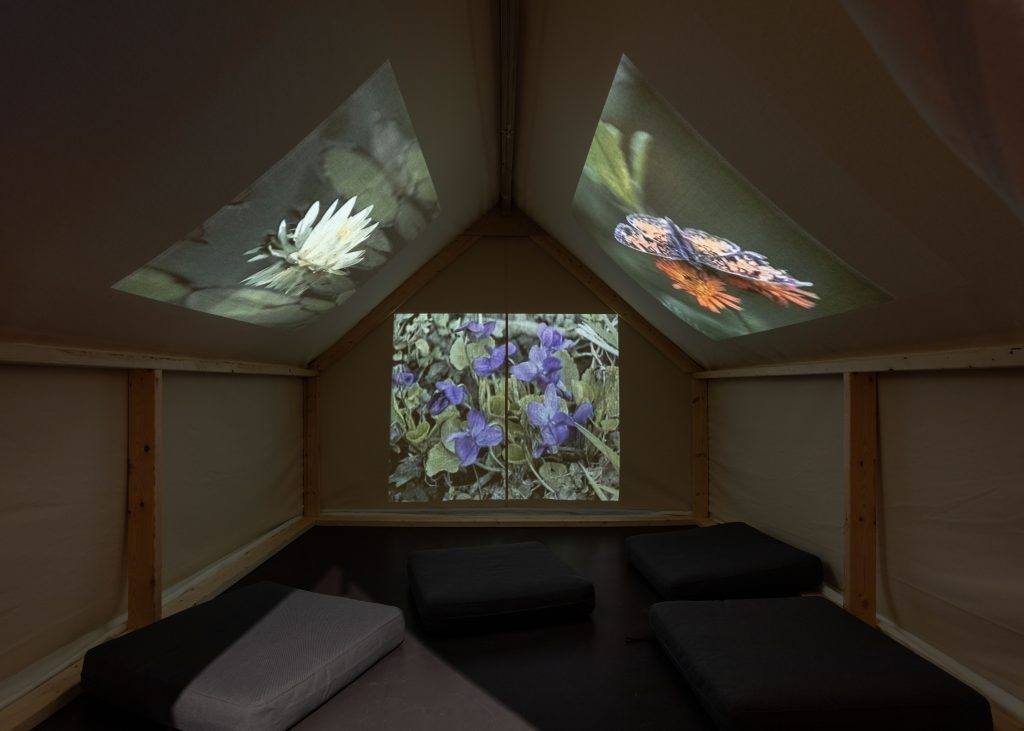
Installation view: Mike MacDonald, Medicine Tent, 1999, in Earthwork. Photo by LF Documentation.

Exhibition Tours: acknowledging the land

1pm, 1:30pm 
Simcoe Hall
27 King’s College Circle

Join a guided tour of acknowledging the land, a long-term installation of contemporary photography from the university’s permanent collection. The installation foregrounds some of today’s most respected Indigenous artists from across Canada, spanning several generations.

Installation view: acknowledging the land in Simcoe Hall. Photo by Toni Hafkenscheid.

Launch Reception for Michael Belmore’s drift

2pm–3pm
King’s College Circle

Internationally recognized GTA-based Anishinaabe artist Michael Belmore, whose new outdoor sculpture exploring the structure of snow fencing is included in Earthwork, will lead an introduction to his work and interests as an artist employing materials and processes that are concerned with land, water, and the environment.

Michael Belmore, drift, 2025. Steel, wood. Courtesy of the artist.


Understanding Serpent Mounds: An Introduction

3pm–4pm 
Seeley Hall, Trinity College
6 Hoskin Ave

The Mounds Research Collective is a SSHRC-funded research network focused on re-storying mounds heritage sites by centring Indigenous knowledge and priorities. The project is based at the University of Toronto, led by Pamela Klassen in collaboration with Mikinaak Migwans and Chadwick Cowie.

In this introductory panel, Klassen, Migwans, and Cowie will introduce “Mounds & Memory: Understanding the Serpent Mounds at Hiawatha First Nation,” the fourth in a series of gatherings connected to the ongoing collaborative relationship between members of the Mounds Research Collective and Kay-Nah-Chi-Wah-Nung Historical Centre of Rainy River First Nations, site of the Manitou Mounds in Treaty #3 Territory. Centring the knowledge and priorities of Hiawatha First Nation as they envision new priorities for their stewardship of Serpent Mounds Park, this event will facilitate the flow of knowledge among Indigenous communities, university researchers, artists, and museums.

Presented in partnership with the Faculty of Arts and Science and the Department of Art History.

Chadwick (Chad) Cowie is from the Michi Saagiig Nishnaabeg community of Pamitaashkodeyong (also referred to as Hiawatha First Nation) and is of the Atik (Caribou) Dodem (Clan). After graduating High School, Chad attended Western University, earning his Bachelor of Arts (Honours) Degree in Political Science and First Nations Studies (2008). Upon finishing his undergraduate studies, Chad served as a Junior Researcher and Policy Analyst for the Chiefs of Ontario (COO). Following his time at COO and a return to Western University, Chad then went on to obtain his Master of Arts Degree in Political Science at the University of Manitoba (2013) and is his Doctor of Philosophy (Political Science) at the University of Alberta (2024). In addition to his research interests, Chad also assisted, and continues to assist, with research and knowledge gathering on behalf of the Michi Saagiig Nishnaabeg communities and Nation. 

Pamela Klassen is Professor of Study of Religion at the University of Toronto. Her books include The Story of Radio Mind: A Missionary’s Journey on Indigenous Land and the forthcoming Making Promises: Treaties, Oaths, and Covenants in Multi-Religious and Multi-Jurisdictional Societies, co-edited with Benjamin L. Berger and Monique Scheer (U of Toronto Press). Her digital storytelling project “Kiinawin Kawindomowin Story Nations” is in collaboration with Kay-Nah-Chi-Wah-Nung Historical Centre of Rainy River First Nations, in Treaty #3 Territory. She is a Fellow of the Royal Society of Canada.

Mikinaak Migwans, a member of Wiikwemikoong Unceded Territory, is an Assistant Professor in the Department of Art History and Curator of Indigenous Art in the Art Museum at the University of Toronto. His research focuses on the politics of placemaking from the land to the museum, with special emphasis on textile arts in Anishinaabe territory. Migwans has worked with the Great Lakes Research Alliance for the Study of Aboriginal Arts & Culture at Carleton University, the Ojibwe Cultural Foundation in M’Chigeeng First Nation, and the National Gallery of Canada in Ottawa. 

Left to right: Chadwick Cowie, photo by Daniel Brett. Pamela Klassen, photo by Jenna Muirhead. Mikinaak Migwans, photo by Eduardo Lima.


Artist Panel: The Practice of Earthwork

4pm–6pm
Seeley Hall, Trinity College
6 Hoskin Ave

Followed by a reception in Earthwork
6pm–7pm
University of Toronto Art Centre

This panel brings together three artists featured in Earthwork—Lisa Myers, Michael Belmore, and Art Hunter—to discuss their practices and reflect on how their works engage with ideas of “Earth work.” Encompassing contemporary art forms such as sculpture, photography, and performance, as well as land-based practices outside of the gallery frame, this panel considers a range of interventions made from Indigenous perspectives. This panel is moderated by Earthwork curator, Mikinaak Migwans.

Following the panel, join us for a reception in Earthwork at the University of Toronto Art Centre together with the curator, some of the artists, colleagues, and the community.

Michael Belmore employs a variety of materials and processes that at times may seem disjointed, yet, the reality is that together his work and processes speak about the environment, about land, about water, and what it is to be Anishinaabe. A graduate of the Ontario College of Art & Design, he completed his Masters of Fine Art at the University of Ottawa in 2019.

Practicing for over 25 years, Belmore is an internationally recognized artist and is represented in the permanent collections of various institutions including the National Gallery of Canada, the Art Gallery of Ontario, and the National Museum of the American Indian – Smithsonian Institute. Belmore is a member of Unsettled Ground Artists Inc and is currently involved in the creation of a multi-year public art project for four light rail stations as part of Phase 2 of Ottawa Light Rail. His exhibitions include: Every. Now. Then: Reframing Nationhood at the Art Gallery of Ontario, Toronto, ON, Shapeshifting: Transformations in Native American Art at the Peabody Essex in Salem, MA and HIDE: Skin as Material and Metaphor at the National Museum of the American Indian – George Gustav Heye Centre in New York.

Seemingly small things, simple things, inspire his work; the swing of a hammer, the warmth of a fire, the persistence of waves on a shore. Through the insinuation of these actions, a much larger consequence is inferred.

Art Hunter is from Manitou Rapids, Rainy River First Nations. Art began contributing to the Story Nations project as an interpreter at Kay-Nah-Chi-Wah-Nung Historical Centre in 2012.  He is interested in learning more about the seven distinct communities that became Rainy River First Nations, and is passionate about preserving and sharing community histories.

Lisa Myers is a curator and artist keen on interdisciplinary collaboration and focuses on various media and materials including video, audio, printmaking, digital arts and socially engaged art approaches. Through her practice, she considers place, underrepresented histories/present/futures, and collective forms of knowledge exchange. As an Associate Professor in the Faculty of Environmental and Urban Change at York University, Myers holds a York Research Chair in Indigenous Art and Curatorial Practice and is the coordinator of the Environmental Arts and Justice program. Myers is an off reserve and proud member of Beausoleil First Nation and is based in both Toronto and Port Severn, ON. 

Mikinaak Migwans, a member of Wiikwemikoong Unceded Territory, is an Assistant Professor in the Department of Art History and Curator of Indigenous Art in the Art Museum at the University of Toronto. His research focuses on the politics of placemaking from the land to the museum, with special emphasis on textile arts in Anishinaabe territory. Migwans has worked with the Great Lakes Research Alliance for the Study of Aboriginal Arts & Culture at Carleton University, the Ojibwe Cultural Foundation in M’Chigeeng First Nation, and the National Gallery of Canada in Ottawa. 

Lisa Myers’ visit to Richard Serra’s Shift. Photo by Mikinaak Migwans.


Contributors

This public program has been developed in partnership with the Mounds & Memory Project, led by Pamela Klassen, Mikinaak Migwans, and Chadwick Cowie, in collaboration with the team of the Art Museum, Hart House Programs, and First Nations House, including Drea Asibey, Day Milman, and Jenny Blackburn. Thanks also to the student tour guides, Grace Blumell, Teri Cronley, Annika Kohli, and Biinizi Smith, and to Shannon Drew, Megan Hull, and Sarina Simmons of the Department for the Study of Religion, as well as to artists Kristina Burton and Jess Howard of Hiawatha First Nation.

Presenting Partners

Art History at UofT Logo
University of Toronto Logo
HartHouse logo in black lettering against white and grey checkered background
University College logo with the crest on the left against a grey and white background
black lettering against a white background for the Canada Council for the Arts
black lettering against a white background for the Ontario Arts Council
Government of Ontario logo

This project is supported through Toronto Arts Council Strategic Funding and draws on research supported by the Social Sciences and Humanities Research Council.

Program Archive

Feature Past Programs